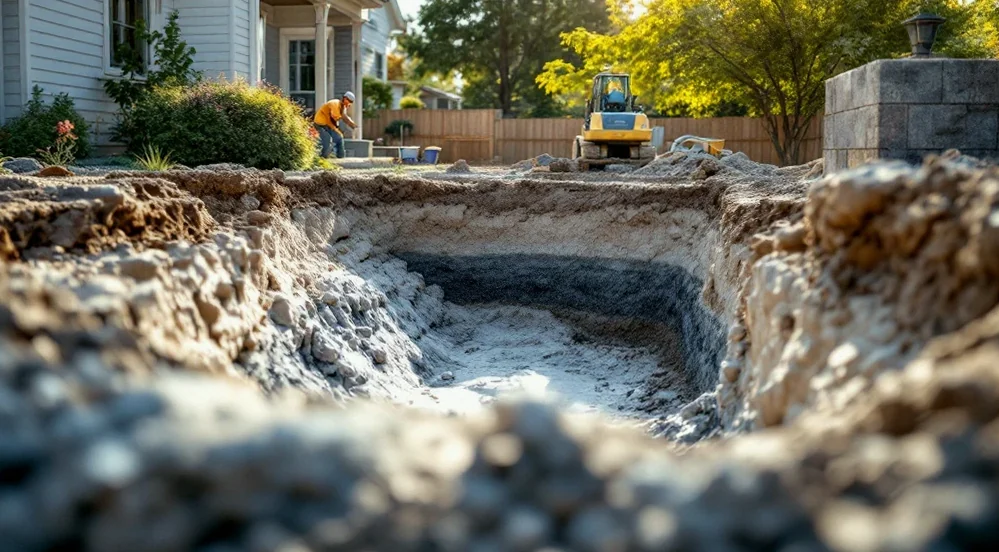
What is Swimming Pool Excavation and how does it work?
Swimming pool excavation is the process of digging out the hole for your pool, shaping the walls and floor, and hauling away the dirt. It's the first major step in building an in-ground pool, and it sets the stage for everything that follows.
Think of it as the foundation of your pool. The hole needs to be exactly the right size and shape, with the walls sloped or stepped to match the pool's design. If the excavation is off by even a few inches, the gunite or fiberglass shell won't fit right, and you'll be paying for rework. That's why this isn't a job for a buddy with a backhoe; it takes a crew that knows how to read the ground and work with the equipment.
In Birmingham, the ground is mostly clay and red dirt, which can be tough to dig but holds its shape well. We hit rock in some neighborhoods, especially closer to the foothills. That changes the game entirely, because rock removal costs more and takes longer. A good excavator will tell you upfront what they see in the soil, not after the machine is already in the yard.
The excavation itself is usually done in a day or two, depending on the size and the soil. The crew brings in a mini excavator or a full-size one, depending on access, and they dig, shape, and haul. The dirt goes into a dump truck, and it leaves your property. That's the part a lot of homeowners don't think about: the dirt has to go somewhere, and that's part of the cost.
- Once the hole is dug and shaped to the pool's exact dimensions.
- Dirt is hauled off-site, usually several truckloads.
- Before the shell goes in, the crew checks for rock, water, and other surprises.
Short version
- Excavation is the first step, and it's where most of the dirt work happens.
- Costs vary widely based on soil, access, and how much dirt you have to move.
- Our crews spot problems early, saving you from expensive surprises later.
How Swimming Pool Excavation works, start to finish
The process starts with a site survey and utility locates, then moves to digging, shaping, and hauling. Here's how we run it in Birmingham.
First, we walk the yard with you and the pool builder. We check the slope, the soil, and where the utilities run. Gas lines, water lines, and electric cables are marked before any machine touches the ground. That's not optional; it's the law, and it keeps everyone safe. We also look at access for the excavator. A narrow side gate means a smaller machine, which means more time and a different cost.
Once the utilities are marked, we bring in the excavator. For most residential pools, that's a mini excavator that can get through a standard fence gate. If you've got a wide open backyard, we might use a full-size machine that moves dirt faster. The operator digs the hole to the depth and shape in the plans, usually starting at the deep end and working toward the shallow.
As the dirt comes out, it goes straight into a dump truck. A typical in-ground pool in Birmingham moves anywhere from 100 to 200 cubic yards of dirt, depending on the size and depth. A cubic yard is 3'x3'x3' and the ratio is typically figured at 1.35 tons of dirt per cubic yard. (riverpoolsandspas.com) That's a lot of weight, and it has to be hauled away, not piled in the corner of your yard.
After the main dig, we shape the walls and the floor. The bottom gets a slope toward the deep end, and the walls get the right angle for the pool's design. We also dig the trench for the plumbing lines and the bonding grid. That's the part people forget about, but it's critical. If the plumbing trench isn't deep enough, the pipes can freeze in winter or get crushed by the surrounding soil.
Finally, we do a walkthrough with the pool builder. They check the dimensions and the slope against the plans. If anything's off, we fix it right then, before the gunite crew shows up. That's what separates a careful crew from one that just digs a hole and leaves.
- Site survey and utility locates.We mark gas, water, and electric lines, and check access for the machine.
- Dig the main hole.The excavator removes dirt in layers, starting at the deep end.
- Shape walls and floor.We cut the slope and angles to match the pool design, including the deep end.
- Haul away the dirt.Truckloads of dirt leave your property, often 20 to 40 loads.
- Final inspection with the builder.We verify dimensions and slope before the shell or gunite goes in.
Why Swimming Pool Excavation matters for your home
The excavation is the foundation of your pool. If it's done wrong, you'll see it in cracked gunite, uneven floors, or a shell that doesn't fit. It's also where a lot of the cost lives, so understanding it helps you budget right.
A pool is a big investment. In Birmingham, a basic in-ground pool runs $60,000 to $80,000, and a mid-range custom pool goes $80,000 to $120,000. (coxpoolsinc.com) The excavation is a small slice of that, but it's the part that can't be redone easily. If the hole is wrong, you're not just patching a crack; you're re-digging.
The excavation also affects your yard's drainage. If the hole isn't sloped right, water can pool against the foundation of your house or your neighbor's yard. That's a headache you don't want. A good excavation crew shapes the surrounding ground to direct water away, not toward your home.
And then there's the dirt. Most homeowners don't realize how much comes out of a pool dig. That dirt has to go somewhere, and hauling it is a big part of the cost. We charge an average of $2500 for digging services, but that's for a straightforward dig with good access. (seaconstruction.net) If you've got a tight yard or rocky soil, it goes up from there.
Getting the excavation right also saves you time. If the hole is ready on schedule, the gunite crew shows up and works without delays. If it's not, you're paying for idle crews and waiting weeks for the next opening. That's money you don't see coming.
The hole is the foundation. Get it wrong, and everything on top of it pays the price.
Common problems and what causes them
The most common problems in pool excavation are hitting rock, finding water, and dealing with poor access. Each one changes the timeline and the cost, and we spot them before they become disasters.
Rock is the big one in Birmingham. Some neighborhoods sit on sandstone or limestone, and the excavator can't just dig through it. That means jackhammering or breaking, which adds hours and wear on the machine. The cost goes up, and the job takes longer. We always check the soil before we quote, but sometimes rock shows up a few feet down that wasn't in the test hole.
Water is another surprise. If the water table is high, the hole fills with water as you dig. That's not just a nuisance; it can collapse the walls and make the dig unsafe. We handle it with pumps and sometimes a dewatering well, but it's extra work and extra cost. In Birmingham, that's more common in low-lying areas near creeks or the Cahaba River.
Access is the quiet killer. A narrow driveway or a side gate that's 36 inches wide means a smaller machine, which digs slower. If there's no way to get a dump truck close, the operator has to use a wheelbarrow or a skid steer to move dirt, and that triples the labor. We've had jobs where the truck had to park on the street and the dirt went over the fence in buckets. That's not a one-day job.
Finally, there's the issue of hauling. Some outfits cut corners by burying the dirt on site or dumping it in a low spot in your yard. That causes drainage problems later. We haul it all away, and we make sure the load is legal. Overloaded trucks are a safety hazard and a ticket waiting to happen.
Rock in the soil
If your area has shallow rock, expect a longer dig and a higher cost. We can test, but sometimes it's a surprise.
High water table
Water in the hole means pumping and possibly dewatering. That adds days and cost, but it's manageable.
Poor access
If the machine can't get to the dig site easily, the job takes longer and costs more. Plan for it upfront.
Frequently Asked Questions
How long does swimming pool excavation take in Birmingham?
Most residential pool digs take one to two days of machine time, but that assumes good soil and access. If we hit rock or water, it can stretch to three or four days. The excavation is usually scheduled a few days before the gunite or shell delivery, so the hole doesn't sit open too long.
How much does it cost to excavate for a pool?
We charge an average of $2500 for digging services, but that's for a straightforward dig. (seaconstruction.net) The cost goes up with rock, water, or tight access. For a basic in-ground pool, the total project runs $60,000 to $80,000, and excavation is a small part of that. (coxpoolsinc.com)
What happens to the dirt from the pool excavation?
It gets hauled away in dump trucks. A typical pool dig moves 100 to 200 cubic yards of dirt, which weighs about 1.35 tons per cubic yard. (riverpoolsandspas.com) That's a lot of truckloads. Some contractors might try to bury it on site, but that causes drainage problems. We haul it all off.
Do I need a permit for pool excavation in Birmingham?
Yes, you'll need a building permit for the pool, and that includes the excavation. Permit costs in Birmingham typically run $1,000 to $2,500. (poolprosglobal.com) Your pool builder usually handles the permit, but the excavation crew needs to know the utility locates are done before we dig.
Can you excavate a pool in a small backyard?
Usually, but access is the deciding factor. If we can get a mini excavator through a 36-inch gate, we can do it. It just takes longer than a wide-open yard, so the cost goes up. We'll walk the property first to see what we're working with.
What if we hit rock during excavation?
We stop and assess. Rock removal adds time and equipment, and the cost goes up. We'll give you a new estimate before we break anything. In some Birmingham neighborhoods, rock is common, so it's not a shock, but it's always a surprise when it shows up.
How deep is a swimming pool excavation?
Most in-ground pools are 6 to 8 feet deep at the deep end, but the excavation is dug a bit deeper to allow for the pool's floor thickness. The exact depth depends on the pool design. We follow the plans from your builder.
Does the excavation include the plumbing trench?
Yes, we dig the trench for the plumbing lines and the bonding grid as part of the excavation. That's part of the job, and it's critical for the pool's circulation and electrical safety. We make sure it's the right depth and slope before we leave.
What should I do to prepare for excavation day?
Clear the area around the dig site, move any sprinkler heads or landscaping that could get in the way, and make sure the gate is unlocked. Let your neighbors know there will be noise and trucks. We'll handle the rest.
Can you remove an old above-ground pool as part of excavation?
We can, but that's a separate job. Above ground pool removal costs $800 to $3,000 on average, and if there's a deck, it can exceed $5,000. (homeguide.com) We'll give you a quote for both the removal and the new dig.
Sources
Need excavation services in Birmingham? Get a free estimate today.
📞 256-857-3227