What are the signs you need Excavation Services?
You need excavation services when water pools against your foundation, your yard has settled into sunken patches, a retaining wall is leaning, or you are adding a driveway, pool, or addition that requires moving dirt. Most residential excavation projects in Birmingham cost between $1,500 and $6,300 depending on scope and site conditions, and a free on-site quote is the only way to know your exact number.
The signs usually show up in a specific order. First you notice water sitting in the same low spot after every heavy rain. Then the grass in that spot thins out and turns to mud. A season or two later you see a crack in the brick veneer or a door that sticks in humid weather. By the time water is visibly running toward the house instead of away from it, the problem has been building underground for a while.
Excavation is not just digging. It covers grading, drainage correction, footing prep, trenching for utilities, and hauling away spoil. When a homeowner calls us about a soggy side yard, the fix is often regrading that section of the lot so it slopes away from the foundation at the right pitch. When someone is building a detached garage, the work starts with stripping topsoil, cutting the pad to grade, and compacting the subbase. Both jobs fall under the same trade.
The cost depends on how much dirt moves and how hard it is to reach. A small regrade around a foundation sits at the low end. A full lot cut with a retaining wall, drainage stone, and haul-off sits at the high end. In Birmingham, the per-cubic-yard cost of excavating land including materials and labor runs between $20.64 and $38.08. (handoff.ai) That range covers everything from easy access on a flat lot to tight backyard work where a mini excavator is the only machine that fits.
Signs you should call us
- Water pools within 10 feet of the foundation after storms
- Sunken or spongy spots in the yard that never dry out
- A retaining wall that leans, bulges, or has cracked mortar
- You are adding a driveway, pool, patio, or room and need dirt moved
If water stands against your foundation for more than a day after rain, get an on-site look before the next wet season. Grading problems get worse with every storm, and the fix is cheaper before the soil has washed out from under a footing.
Warning signs to watch for
Watch for water that stands against the foundation, soil that has pulled away from the slab, cracks wider than a credit card in brick or block, a retaining wall that has moved off plumb, and a yard that slopes toward the house instead of away from it. Any one of these means the ground around your home is not doing its job.
Start with the simplest test. After a hard rain, walk the perimeter of your house and look for the lowest point. If that low point is within a few feet of the foundation, you have a grading problem. Water that sits there for hours seeps into the soil, and that soil expands and pushes against the foundation wall. In Birmingham we see this on lots all over the metro, from older homes in Crestwood and Forest Park to newer builds in Hoover and Trussville.
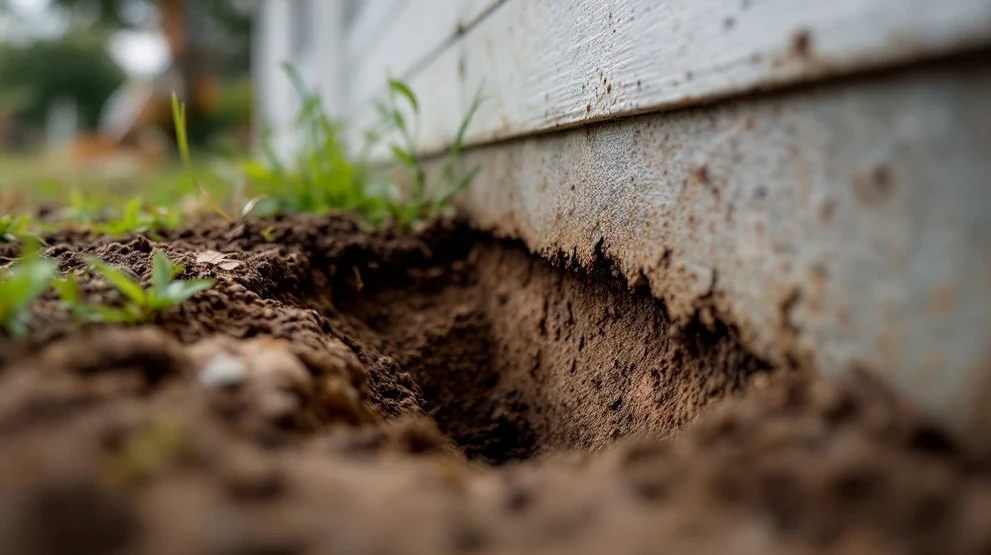
Soil pulling away from the slab is another clear signal. You will see a gap between the dirt and the concrete, sometimes an inch or more wide. That gap lets water run straight down the foundation wall instead of shedding away. It also means the soil has compacted or washed out, and the support under the edge of your slab is not what it was.
Cracks tell you how long the problem has been going. A hairline crack in a garage slab is common and often harmless. A stair-step crack in a brick wall, or a crack you can slide a quarter into, points to movement in the foundation. When you see that plus a door that sticks only in wet weather, the soil is swelling and shrinking with the seasons, and the foundation is moving with it.
Retaining walls fail slowly and then all at once. Look for bulging, a lean toward the street, or mortar joints that have opened up. Water pressure behind the wall is what pushes it over. If the wall has no drainage stone or weep holes, it is holding a reservoir of water every time it rains, and that pressure has to go somewhere.
- Water standing within 10 feet of the foundation after rain
- Visible gap between soil and the edge of the slab
- Stair-step cracks in brick or block wider than a quarter inch
- Retaining wall leaning, bulging, or missing weep holes
- Yard sloping toward the house instead of away
- Recurring mud pit in the same spot every winter
Minor pooling
Water sits in one low spot for a few hours after heavy rain but drains by the next day. Note it and check again after the next storm.
Standing water near foundation
Water stays against the foundation for a day or more, or you see a gap between soil and slab. Schedule an on-site look within a few weeks.
Cracks and wall movement
Stair-step cracks in brick, a leaning retaining wall, or a door that sticks only in wet weather. Call us now; this is active movement.
What causes these problems in Birmingham
Birmingham sits on red clay that swells when wet and shrinks when dry, and our storms drop a lot of rain in a short time. That combination moves soil, undermines slabs, and overwhelms drainage that was never sized for a downpour. Add mature trees pulling moisture out of the ground and decades of settling, and you get the grading and foundation issues we see every week.
The clay is the main character. Around Birmingham, the soil under most yards is a heavy red clay that holds water and expands. When it dries out in summer, it shrinks and pulls away from foundations and utility lines. When it soaks in winter, it swells and pushes. That cycle repeats every year, and over time it moves things that were not built to move.
Our rain comes in bursts. A summer thunderstorm can drop two inches in an hour, and the ground cannot absorb it fast enough. Water runs to the lowest point, which is often right against the house if the lot was graded flat or has settled over the years. Downspouts that dump next to the foundation make it worse. So does a driveway that slopes toward the garage instead of away from it.
Trees are a factor too, and not just for shade. Large oaks and pines pull hundreds of gallons of water out of the soil each week. That drying shrinks the clay and can cause settlement under a slab. On the flip side, removing a big tree can cause the soil to stay wetter than it used to, which changes how the ground behaves around the foundation.
Older neighborhoods have their own issues. Homes built before modern grading standards often have lots that were shaped by hand with whatever dirt was on site. Over 50 or 60 years, that dirt has settled, eroded, and been dug into for additions, pools, and utility repairs. What looks like a flat yard today may have been graded to a different shape when the house was new.
Worth fixing now
- Water pooling against the foundation
- A retaining wall that has moved
- Grading that sends water toward the house
- A sunken area where a utility trench was backfilled
Can often wait
- A single hairline crack in a garage slab
- Minor settling in a flower bed away from the house
- A low spot in the yard that dries within a day
- Cosmetic unevenness in a gravel driveway
What happens if you ignore the signs
Ignoring grading and drainage problems lets water keep working on your foundation, and that leads to cracked brick, sticking doors, uneven floors, and in bad cases a foundation repair bill that dwarfs the cost of regrading. A retaining wall that is left alone will eventually fail, and the dirt behind it will end up in your driveway or your neighbor's yard.
<p>Water is patient. A small low spot that holds water against the foundation for a few hours after each storm will, over a couple of years, wash out the soil under the edge of the slab. Once that happens, the foundation has less support, and you start to see cracks in the interior drywall, doors that no longer latch, and floors that feel uneven underfoot. Fixing the foundation after it moves is a much bigger job than fixing the grade before it does.</p>
Retaining walls fail in a way that is hard to miss. The wall leans further each season, and then one heavy rain pushes it over. When that happens, the soil behind it slides, which can take out a fence, bury a driveway, or damage a neighbor's property. Rebuilding a failed wall costs more than repairing one that was still standing, because you are now moving dirt that has already slumped and dealing with whatever it damaged on the way down.
There is a permit and inspection angle too. If you are adding a structure, most Birmingham-area jurisdictions require a grading plan and inspections at certain stages. Doing excavation work without a permit can stall your project, and you may have to undo work to get it approved. We handle the dirt work and coordinate with the inspector so the project keeps moving.
The cost math favors acting early. A regrade and drainage fix on a typical Birmingham lot often lands in the lower half of the $1,500 to $6,300 range for residential excavation. (angi.com) A foundation repair after years of water damage can run several times that, and it does not fix the grading that caused the problem in the first place.
Year 1
Water pools in the same spot after storms. Grass thins out and the soil stays soft for days.
Years 2 to 3
Soil washes out from under the slab edge. Hairline cracks appear in drywall and brick. Doors start to stick in wet weather.
Years 4 to 5
Cracks widen. Floors feel uneven. A retaining wall leans. Foundation repair becomes a separate, larger project.
Frequently Asked Questions
How much does excavation cost in Birmingham?
Most residential excavation projects in Birmingham run between $1,500 and $6,300, depending on how much dirt moves and how tight the access is. (angi.com) The per-cubic-yard cost of excavating land, including materials and labor, ranges from $20.64 to $38.08. (handoff.ai) Larger jobs with haul-off and retaining walls tend to land toward the upper end. A free on-site quote is the only way to get an exact number for your lot.
Do I need a permit for excavation work in Birmingham?
It depends on the scope. A simple regrade of an existing yard usually does not need a permit. Cutting a new pad for a garage, building a retaining wall over a certain height, or changing how stormwater leaves your property often does. Most Birmingham-area jurisdictions require a grading plan and inspections at set stages for structural work. We handle the dirt work and coordinate with the inspector so nothing stalls.
Can you fix a soggy yard without tearing up the whole lawn?
Often, yes. If the problem is a low spot against the foundation, we can regrade that section and tie it into the existing slope. If the issue is a downspout dumping next to the house, we can extend it or add a dry well. Full-lot regrades are sometimes needed, but many jobs are smaller than homeowners expect. We walk the yard with you and point out what needs to change.
How long does a typical excavation project take?
A small regrade or drainage fix can be done in a day or two. A larger job, like cutting a pad for an addition or rebuilding a retaining wall, can take a week or more depending on weather and how much dirt has to be hauled off. Birmingham rain can slow things down, so we build a weather cushion into the schedule. We give you a realistic window before we start.
Will excavation damage my landscaping or driveway?
Some disruption is unavoidable when you move dirt, but we plan the route in and out before the machine shows up. We protect driveways with mats when needed, avoid root zones where we can, and put the yard back as close to how we found it as possible. If a section of lawn has to come up, we tell you up front so there are no surprises.
What is the difference between grading and excavation?
Excavation is the digging and moving of soil, whether that is cutting a pad, trenching for utilities, or removing dirt for a pool. Grading is shaping the surface so water flows where it should. Most jobs involve both. You dig to get the right depth, then grade to get the right slope. We handle the whole process, so you are not coordinating two different crews.
How do I know if my retaining wall needs to be replaced or just repaired?
If the wall is leaning, bulging, or has cracks wider than a quarter inch, it usually needs to be rebuilt rather than patched. A wall that is still plumb but missing drainage stone or weep holes can often be saved by adding drainage behind it. We look at the wall, the soil behind it, and how water moves across the lot before recommending a fix. Rebuilding is sometimes the cheaper option over the long run.
Can excavation work be done in winter or during rainy season?
Yes, with planning. Winter in Birmingham is usually mild enough to dig, though wet spells can make the ground too soft for heavy equipment. We watch the forecast and schedule around the worst of it. If a job has to pause for rain, we protect the open ground so it does not wash. Spring and fall are the busiest times, so booking early helps.
What should I have ready before you come out for a quote?
Know where your utility lines run, have a rough idea of what you want the finished yard or pad to look like, and clear any vehicles or equipment from the area we need to see. If you have a survey or a site plan, have it handy. The more we know about what is underground and what you are trying to achieve, the more accurate the quote will be.
Do you haul away the dirt you dig up?
We can, and on most jobs we do. Some homeowners want to keep clean topsoil for garden beds or to fill a low spot elsewhere on the property. We sort what is worth keeping from what needs to go, and we factor haul-off into the quote. If you want to keep any of it, tell us before we start so we can stockpile it where you want it.
Sources
Need excavation services in Birmingham? Get a free estimate today.
📞 256-857-3227